


On June 18, in Nepal, a young Madheshi individual from the outskirts politically, socially marginalized, economically deprived areas, and culturally distinct from the main Bahun-Chhetri-Newar (BCN) populace found Kathmandu quite foreign during the early '70s. Staying briefly within an old Rana-era house featuring corroded gates, decaying wooden entrances, and deteriorating walls, he likely experienced confusion amid his new environment initially.
The spring beneath the old bedframe in the spacious first-floor chamber of the mansion remained operational, though it seemed a resident mouse had honed its claws on the sides of the latex pad. The toilet situated in a separate building frequently overflowed into a small trench near the outer boundary wall. A pipe dripped water directly onto the ground, necessitating collection using metal pails, which were then transferred to cooking vessels for storage. Opting for cleansing oneself at Sundhara proved far more practical than utilizing the rusty tin can and aluminum cup amidst what used to be a lush garden area now reclaimed by nature.
Several weakened hippies often visited the unprotected area to gently rub the leaves of the spontaneously growing cannabis plants there, later using dull blades to remove the residual green substance from their hands. At one point, hashish was legal and could be freely purchased from various small shops around Jhochhen Tole, which earned itself the nickname "Freak Street." However, when it became illegal in mid-1973, certain police officers pulled out these plants instead.
The narrow lanes of Old City Basantpur underwent cleaning and paving for King Birendra’s crowning in 1975; however, it required assistance from Germany to establish a proper waste management system during the 1980s. Despite having Nepal's first democratically elected mayor in 1947, Kathmandu lacked an established political culture where local councils would be accountable to citizens. The inefficacy of the Nagar Panchayat became evident as it struggled under the autocratic reign of Shah monarchs and their loyalists known as Panchas.
Municipal malfunctioning
Right up to the restoration of democracy in 1990, one of the main duties of every elected representative in local Panchayat was to muster huge crowds in support of the royal family. The birthday of King Birendra on Poush 14, the memorial day of his father on Poush 1, the day of tribute to his grandfather on Falgun 7 and the day of commemorating the founder of Shah dynasty on Poush 27 were celebrated according to Bikram Sambat calendar every year with pomp and show, as were the birthdays of his stepmother on Bhadra 4 and that of his wife on Kartik 22.
Since the municipal body lacked legislative authority, it had to rely upon the generosity of line ministries in Singha Durbar to execute routine tasks-an anomaly that continues to incapacitate local and provincial governments of republican Nepal. There were no guidelines for building houses that had begun to sprout in the rice paddies with little road access, no pipeline and wires hung on bamboo poles for connection to the electric grid.
Historical cities often developed around key areas of spiritual, military, economic, or governmental influence. In contrast, many contemporary cities are either deliberately designed or subject to some form of regulation. Some natural cities emerge organically through history starting typically with a trading hub or regional support center. Cities can also expand uncontrollably when transportation routes like rivers or roads facilitate easy mobility, leading to uncontrolled sprawl and difficult-to-manage communities. Distinctively different from conventional, organized, controlled, or even spontaneously grown towns, the political landscape under populist autocratic rule reshapes older settlements such as Dhaka, Karachi, or Kathmandu into disorderly metropolises.
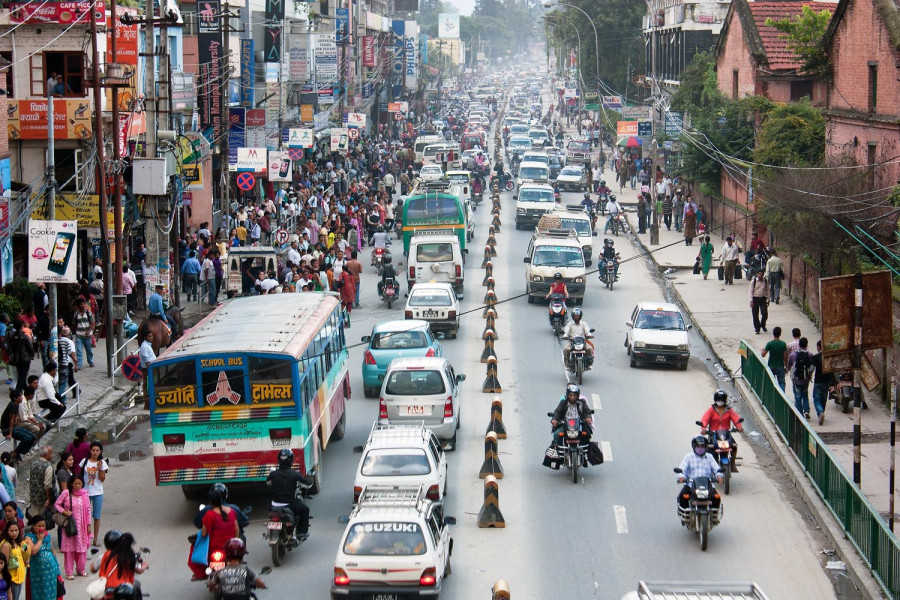
Over just five decades, Kathmandu has transformed beyond recognition. Its population has surged dramatically; when including the substantial number of transient residents, the city now hosts well over 5 million individuals at any one moment. Structures have grown taller, thoroughfares have widened, automobiles abound, and large shopping centers overshadow major avenues with their presence, alongside upscale eateries serving innovative hybrid dishes once unfamiliar here. A misguided embrace of modernization—one that prioritizes consumption over civic duty—has eroded the public’s desire for freedoms, equalities, brotherhoods, and secular values so profoundly that improving living conditions, educational opportunities, healthcare access, and transit systems for underprivileged urban dwellers remains low on the agenda of municipal authorities.
The capital has become the hub of human trafficking, with high-ranking ministers implicated in several scandals. There is widespread acceptance of unequal access to education and healthcare between the wealthy and impoverished segments of society. When former Prime Minister Baburam Bhattarai reduced sidewalk widths to accommodate more vehicles, the affluent were pleased. Similarly, the middle class cheered Mayor Balendra Shah’s decision to evict street vendors without providing alternatives. As a result, navigating from one location to another inside the city has turned into a significant challenge; notably, the span from the central area to the Ring Road spans merely around five kilometers.
Private transport
Even with serious concerns over the limited space within the saucer-like valley and the environmental constraints this places on expansion, individuals persist in moving to Kathmandu from all corners of Nepal. Although the introduction of Melamchi water supply has alleviated some pressure, sewage systems frequently back up and local rivers emit unpleasant odors. A dense smog often shrouds the area year-round, save for the rainy season, making life in the city difficult. Nonetheless, it’s the difficulties associated with daily travel that drain the vitality of those striving to earn their livelihoods in this bustling urban center.
Following his relocation of the capital from Gorkha to Kathmandu in 1768, Prithvi Narayan Shah saw Kathmandu as an ideal stronghold and thus enforced strict regulations on who entered and exited the valley. This policy remained intact until the end of Rana rule in 1951. To those mountainous elites who had emerged triumphant, the notion of communal transportation seemed inconceivable; how could nobles and ordinary citizens ride together equally within one conveyance? The autocratic Shah monarchs adhered to this ideology. It wasn’t until after the waves of liberalism, privatization, and globalization in the 1990s that owning cars became increasingly widespread among people.
To decrease oil imports and manage air pollution, the government has initiated policies promoting the importation of electric vehicles (EVs). Despite knowing that personal automobiles have little impact on improving mobility, enhancing productivity, or achieving social equity. Major roads frequently become congested with stationary vehicles throughout the day and filled with parked cars at night, with this issue showing no signs of resolution. Nonetheless, these alternatives might not appeal to the affluent segment that largely shapes public discussions.
Having different tariffs for internal combustion engine (ICE) cars and electric vehicles (EVs) used as personal transportation doesn’t seem logical. Instead, we could offer advantages to public transit options like EV trucks, buses, and cabs. Singapore effectively manages this with an open bidding system called the Certificate of Entitlement (COE) coupled with the Vehicle Quota System (VQS). Meanwhile, CUMTA in Chennai mandates evidence of off-street parking before allowing someone to register a vehicle. Similarly, the Maharashtra state government plans to enforce a requirement making dedicated parking spaces necessary for those purchasing cars.
Lacking effective public transit, it will be challenging to manage the urban disorder in Kathmandu. The commitment to establish a walker-centric transport system has been delayed for far too long.
0 Komentar